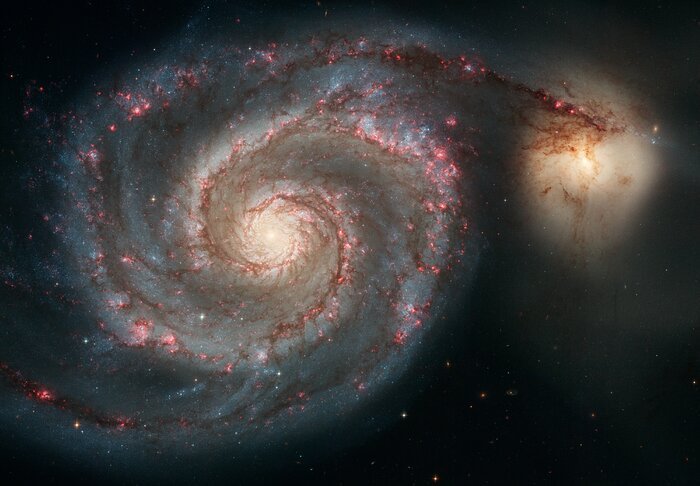
Credit: NASA, ESA, S. Beckwith (STScI), and The Hubble Heritage Team (STScI/AURA)
Space is full of interesting wonders occurring all the time. The galaxies also don’t remain static forever; they can sometimes form new structures through mergers.
In this expanding universe, galaxies are found to be constantly moving. While passing by, if a galaxy gets caught in the gravitational field of the other, the tug of gravity entangles them. This can lead to a coalition of one or more galaxies with their structures perturbed. A galaxy merger can cause turbulence inside the galactic structure by disturbing the stellar mass density. Mergers can be divided into major and minor mergers. If two equally massive galaxies merge, it’s called a major merger. If it’s a smaller galaxy being consumed by a relatively larger one, it’s called a minor merger. A galaxy merger may initiate new star formation in the turbulent galactic dust clouds. However, these galactic mergers don’t happen swiftly; instead, they gradually coalesce over billions of years.
Cutting-edge observational methods have revealed many galaxy mergers unfolding in the cosmos. Here are some well-known mergers observed by astronomers.
1- Arp 143 is a duo of galaxies, NGC 2445 and NGC 2444, that resulted from a gravitational interaction. The dominant one is NGC 2444, which is pulling the gas from its companion toward itself.
2- The pair of Arp 273 is also a striking result of gravitational exchange between two spiral galaxies. One of them is subtly being pulled around the other.
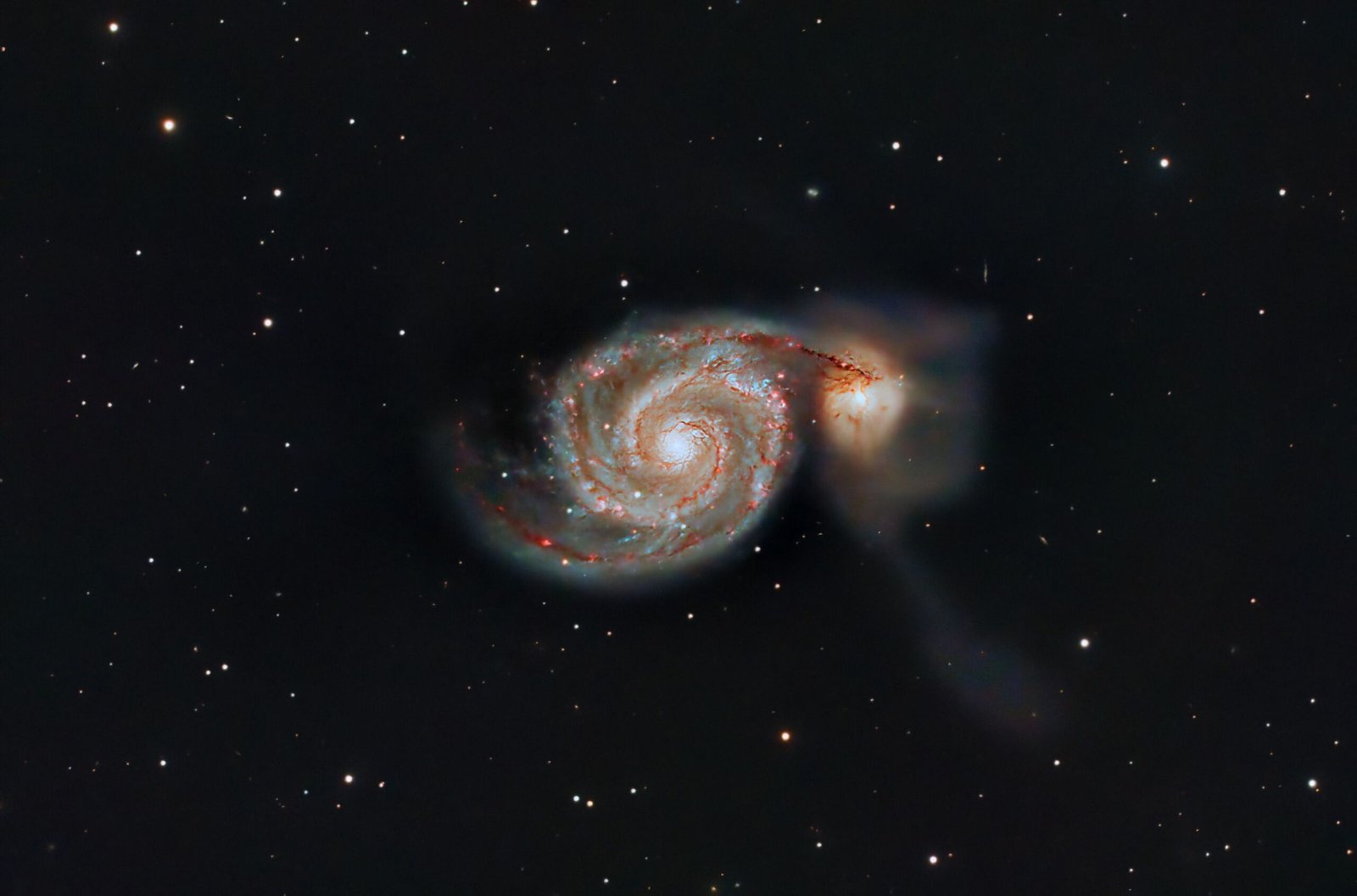
3- M51a, also known as the Whirlpool galaxy, is a spiral galaxy 65 light-years in diameter. The Whirlpool galaxy is blending with a smaller galaxy named M51b. M51b has been approaching the spiral arms of the Whirlpool galaxy for a billion years. Researchers predict that they will eventually merge.
A galaxy merger can affect the stellar mass density and form new structures. Scientists study galaxy mergers to gain insights into how the universe is evolving.

Leave a Reply