A remarkable way gravity helps astronomers is that it works as a natural magnifier for distant objects in space. Want to know how that works? Let’s dive in!
According to Einstein’s theory of general relativity, an object’s mass causes the space-time fabric to curve, and that curvature pulls nearby objects towards it. From this notion, it was predicted that this warping would also affect the path of light, causing it to bend.
When massive objects distort space-time, light passing through it also bends. This distortion works like optical lenses or prisms that deflect light rays. This deflection can either magnify the image of the source or produce multiple images of the same object. Such bending of light due to gravity is called gravitational lensing. In space, an object with enough mass to distort spacetime will act as a lens for foreground stars or galaxies, magnifying their images. For instance, a massive galaxy cluster, Abell 370, acts as a lens that deflects the incoming light rays from a distant faint galaxy, forming an arc around it, which allows astronomers to view distant bodies that would otherwise be invisible.
The first confirmation of gravitational lensing came after the 1919 solar eclipse. Scientists anticipated that the Sun’s gravity would deflect starlight and the position of stars would appear shifted. During an eclipse, the Sun is between the stars and the Earth; hence, the Sun’s light is blocked, and we can see the distorted light from the stars behind it. In this experiment, it was observed that the gravitational field of the Sun was causing the light from the background to bend.
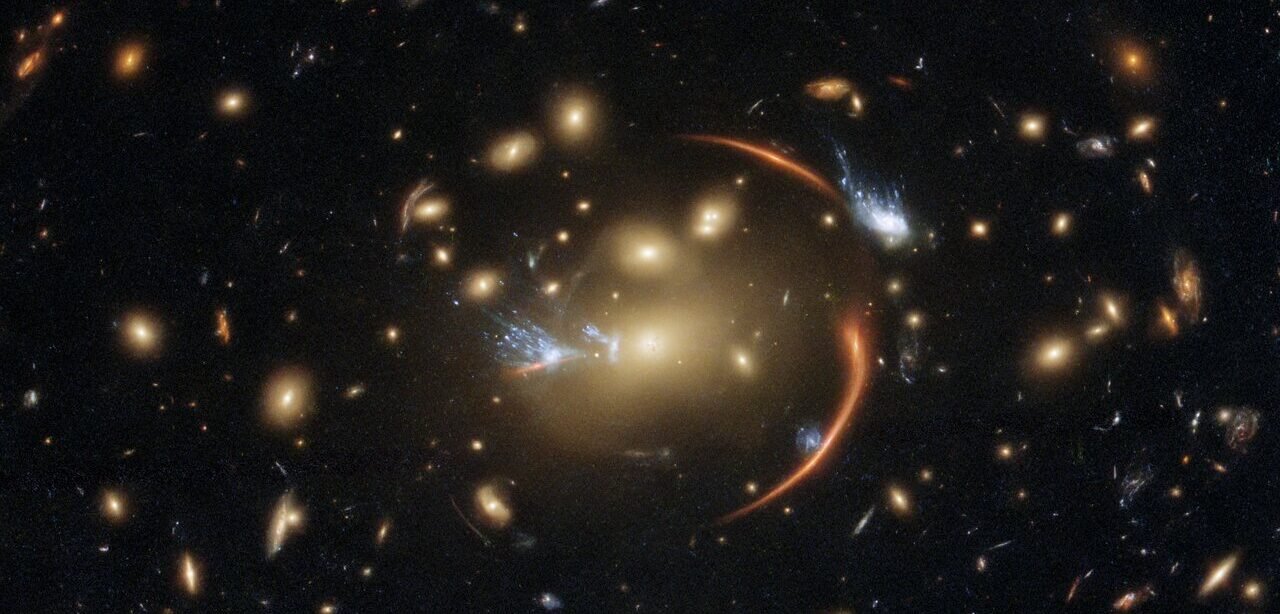
Credit: ESA/Hubble & NASA, A. Newman, M. Akhshik, K. Whitaker
The effect of gravitational lensing has been utilized in several space missions and projects. The Kepler space telescope and James Webb telescope apply gravitational lensing to identify exoplanets and distant galaxies. The Roman space mission will use this phenomenon to unveil the hidden dark matter.
References:
- Schneider, P. (2006). Introduction to gravitational lensing and cosmology. In Gravitational Lensing: Strong, Weak and Micro (pp. 1-89). Berlin, Heidelberg: Springer Berlin Heidelberg.
- Mollerach, S., & Roulet, E. (2002). Gravitational lensing and microlensing. World Scientific.
- Narayan, R., & Bartelmann, M. (1996). Lectures on gravitational lensing. arXiv preprint astro-ph/9606001.
Leave a Reply