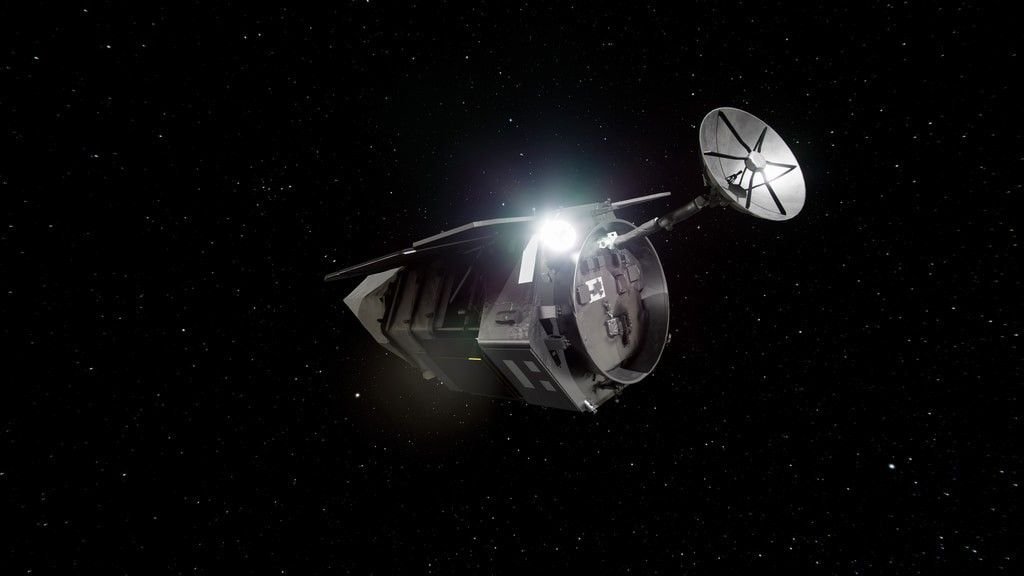
Nancy Grace Roman Telescope has been launched in hopes of investigating the mysterious dark matter and dark energy. It is equipped with a wide-field instrument that can convert infrared light from stars into electrical signals, which will be used to produce high-resolution images of space. The equipment is advanced enough to capture very faint infrared signals, allowing scientists to detect what was previously impossible. We know that the expansion of the universe causes the wavelength of visible and ultraviolet light to stretch into infrared wavelengths, which is hard to detect from Earth.
Components of the Roman Telescope
The Roman telescope is a combination of different components. Firstly, the optical telescope array contains a 7.9-foot-wide primary mirror, although it weighs even less than Hubble. It holds a 400nm layer of silver, corresponding to a width less than average hair! When the light grazes the primary surface, it is reflected and focused by a curved primary mirror, then further reflected into a secondary mirror. The detector array then converts the light signals into electric signals. The Roman telescope also hosts a Wide Field Instrument (WFI) and a Coronagraph. The WFI is an infrared camera with high angular resolution. The Coronagraph blocks the flare of distant stars to detect the faint light signals from the exoplanets orbiting them. The exoplanets that are cold and older than the usual hot Jupiter-like worlds are very hard to detect. However, a coronagraph will solve this exact problem and allow us to see a diverse variety of exoplanets that we couldn’t before.
How does it help with the search for dark matter & dark energy?
According to general relativity mass cause the space to curve which can cause the light passing through to bend also called gravitational lensing effect. The Roman telescope will detect weak gravitational lensing caused by dark matter and study its nature by observing its effect on normal matter. By separating the distribution of normal matter and dark matter, we can get a better understanding of the universe. By the lensing effect, it will study the warped view of distant galaxies. Dark matter is assumed to drive galaxy formation; if galaxies formed in the early universe, it could suggest that dark matter is composed of heavier particles. On the other hand, if those particles were light, it would take longer for galaxies to form.
Dark energy is considered the driving force of the accelerating expansion of the universe. The expansion is proven by the redshift of the galaxies. By studying the redshifts and matter distribution in the universe, scientists can study the evolution of dark energy.
References:
- Jung, S., & Shin, C. S. (2019). Gravitational-wave fringes at LIGO: Detecting compact dark matter by gravitational lensing. Physical review letters, 122(4), 041103.
- Nierenberg, A. M., Gilman, D., Treu, T., Du, X., Gannon, C., Paugnat, H., … & Wong, K. C. (2026). Measurement of the Minimum Cold Dark Matter Halo Mass with Strong Gravitational Lensing. Physical Review Letters, 137(7), 071001.
- Gilman, D., Nierenberg, A. M., Treu, T., Abazajian, K. N., Anguita, T., Bennert, V. N., … & Wong, K. C. (2026). Free-Streaming Length of Dark Matter from JWST Observations of 28 Strong Gravitational Lenses. Physical Review Letters, 137(8), 081004.
Leave a Reply